

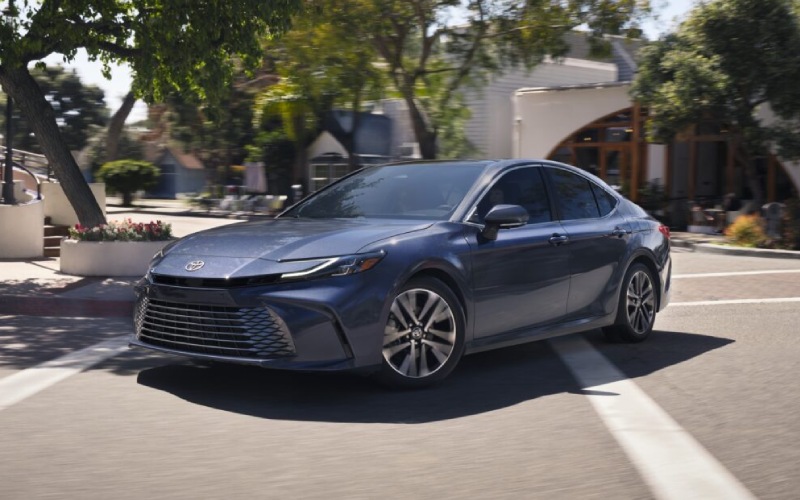
Jones Toyota - Does AWD give the 2026 Toyota Camry an advantage over the 2026 Honda Accord around Timonium, MD?
When shoppers ask us whether AWD matters in a midsize sedan, they’re really asking about confidence. Confidence pulling away from a damp light, rolling through an unexpected slick patch, or angling out from a side street with sand and debris near the shoulder. In that context, the 2026 Toyota Camry’s available Electronic On-Demand All-Wheel Drive is more than a spec line; it’s a real, everyday advantage over the front-drive-only 2026 Honda Accord around Timonium, MD.
Here’s why: Toyota adds a dedicated rear electric motor that automatically engages when slip is detected, routing torque to the back wheels seamlessly. You don’t have to think about it, toggle it, or plan for conditions—the system simply helps you go. That’s especially helpful when a morning sprinkle leaves roads glassy, or when you’re easing out from a side street with broken pavement and paint stripes. The Accord is stable and predictable, but with power solely to the front, it has fewer options to put traction to the ground when the surface is less than ideal.
How the Camry’s hybrid and e-AWD work together
Because the 2026 Camry is all-hybrid, every grade starts with instant electric torque. It’s the sensation you feel when the car steps out cleanly from a stop, smoothing the first 20–30 feet in traffic. Add the available rear e-motor for AWD, and now the Camry can apply that initial surge more evenly front to rear. The result is a gentle, sure-footed launch that reduces wheelspin and helps maintain your steering line. Toyota’s tuning is subtle—no lurching, no surprise clutching, just the sense that the car has more composure where others might scramble.
Honda’s hybrid system is refined and efficient, and its 204-hp output is solid. But the Camry’s hybrid delivers up to 232 net combined horsepower on AWD models, so you’re getting both the benefit of all-weather traction and a stronger overall power figure in one package. For drivers who split time between surface streets, I-83 ramps, and quick detours on York Road, that blend of traction and power makes daily driving feel less like a compromise and more like a steady stride.
Driver assistance that complements traction
AWD works best when it’s supported by smart driver-assistance that helps keep you poised in traffic and on the highway. Toyota Safety Sense™ 3.0 is standard across the Camry line, with Lane Tracing Assist, Full-Speed Range Dynamic Radar Cruise Control, and available Traffic Jam Assist. The assist systems are tuned to feel natural—not intrusive—by signaling clearly in the cluster and the available Head-Up Display. That gives you an extra layer of calm when traffic bunches near the Beltway or a sudden slowdown exposes a shiny, slick patch ahead.
The Accord counters with Honda Sensing®, including Collision Mitigation Braking System™, Adaptive Cruise Control with Low-Speed Follow, and Lane Keeping Assist with Traffic Jam Assist. It’s an excellent suite. The difference is that the Camry can combine those assists with torque routed to four wheels when the road demands it. Your steering inputs feel more consistent, and your exit from the slick zone more predictable.
Real-world benefits you’ll feel around town
The Camry’s available 4-mode drive selector—Normal, Eco, Sport, and EV Mode—lets you tailor response to your route. Normal keeps things smooth, Eco trims throttle sensitivity for longer drives, Sport adds urgency for merges, and EV Mode lets you glide quietly at low speeds for short distances when conditions allow. Paired with e-AWD, you get a sedan that adapts to daily realities: puddled gutters after a quick sprinkle, leaves that slick up at a four-way stop, or ripples of gravel near construction.
Technology seals the deal for usability. The Camry offers an available 12.3-inch center display running Toyota’s latest multimedia, an available 12.3-inch Digital Gauge Cluster for sharp, at-a-glance readouts, and an available Head-Up Display that keeps speed and assist status on the windshield. Add the available 9-speaker JBL® Premium Audio System and standard Blind Spot Monitor with Rear Cross-Traffic Alert, and the car simply feels designed for daily confidence.
Common follow-up questions about AWD in a sedan
Many drivers want to know whether AWD adds weight or complexity that makes a car feel sluggish. In the Camry’s case, the hybrid’s electric torque helps offset mass with quick, low-speed response, and the e-AWD system only engages when needed, keeping efficiency in mind. Others ask whether AWD changes maintenance. The Camry’s system is electric at the rear, which means fewer traditional AWD components and no driveshaft to the back—a design that prioritizes simplicity.
Finally, some drivers wonder whether AWD helps only in the worst weather. The short answer: no. The biggest day-to-day benefit is smoother launches and more predictable traction on imperfect surfaces—the exact conditions you meet year-round in suburb-to-city driving. It’s the difference between a car that scrambles briefly and a car that simply rolls where you point it.
Who should prioritize AWD in this comparison?
If your commuting mix includes neighborhood streets with variable surfaces, highway ramps that can gather debris, or frequent trips during early-morning hours when a thin layer of moisture can linger, the Camry’s available AWD is a tangible benefit. Add in Toyota Safety Sense™ 3.0 and features like the available Head-Up Display, and you get a suite that doesn’t just react to conditions—it helps you stay a step ahead.
By contrast, if you spend nearly all your time in dry, consistent conditions at steady speeds, you may place less value on AWD and focus on cabin features. Even then, the Camry’s available 12.3-inch displays, refined ride, and all-hybrid lineup bring unique strengths that stand on their own.
Frequently Asked Questions:
Does AWD make the Camry feel heavier or less responsive?
No. The hybrid system’s instant electric torque helps the Camry feel quick off the line, and the electric rear motor engages only when needed, maintaining a smooth, responsive character.
Is AWD helpful only in snow?
It helps year-round. AWD adds poise on wet patches, painted crosswalks, leaves, gravel, and uneven surfaces—common in daily driving, especially through transitions and intersections.
What about driver-assist features—are they different with AWD?
Driver assists like Lane Tracing Assist and Traffic Jam Assist function similarly; the advantage is that with available e-AWD, the Camry can also send torque rearward when slip is detected, complementing those assists with extra traction.
Which car has AWD—Camry or Accord?
The 2026 Camry offers available Electronic On-Demand AWD. The 2026 Accord is front-wheel drive only.
In short, if you want the added composure of AWD plus the polish of modern displays, available JBL® audio, and Toyota Safety Sense™ 3.0, the Camry places a distinct check mark in the “confidence” column. Jones Toyota, serving Edgewood, Baltimore, and Timonium, can walk you through trims and options so you can choose the configuration that best matches your routine.
Ready to take the next step? Schedule a test drive, feel the difference in traction and throttle response for yourself, and see why one well-rounded system can elevate the whole driving experience with a midsize sedan. Whether it’s a rainy morning, a damp parking-garage exit, or simply a busy day with lots of turns, the Camry’s available e-AWD helps you stay composed and in control.
One visit is all it takes to feel how Toyota’s hybrid tuning and available all-wheel traction come together in a sedan that’s built for real-world Maryland driving.
Stop by and try it—you’ll understand the advantage the moment you pull away from the curb.
Jones Toyota is here to help you compare features side by side and find the right match for your everyday life.
Request more 2026 Toyota Camry information
Categories:
Toyota Camry